Web Application Development

Custom Web Development
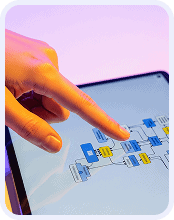

Built for businesses whose requirements don't fit a standard platform.

Web application to fit your business

Custom development applies when the gap between what a platform offers and what the business needs is too wide to bridge with workarounds. The build is scoped to the exact problem and owned outright.

Full ownership

The software is an owned asset. Changes, extensions, and migrations happen on the business's own terms.

Exact fit

Custom development is scoped to the workflow, data model, and integration requirements this business actually runs on.

Built to scale

The system is designed for the expected load and rate of change.

Speed to adapt

Off-the-shelf platforms release features on their own schedule. Custom software changes when the business does.

Custom web solutions

The architecture, the discovery questions, and the delivery approach are distinct for each build type. Specificity starts from the first conversation.

MVP Development

The fastest path from idea to working product.
What's included
Scope consultancy backed by evidence sheets, helping the client identify the fastest route to a testable product without overbuilding
Clearly defined feature boundary separating what ships in v1 from what follows based on real validation data
News and events modules for company-wide communication and internal scheduling in one place
AI-assisted development that compresses build time without compressing quality: the MVP ships faster and the codebase is already structured to scale into v1 without a rewrite
Architecture that supports iteration, so the first version doesn't require structural changes when the next phase begins
An MVP is the minimum set of features needed to test a real business assumption, not a stripped-down version of the full product. The scope is defined through structured consultancy: evidence sheets, clear options, and the client owning the final decision on what ships first.
Start Your MVP

SaaS Development

A complete software product built to sell and manage at scale.
What's included
Resilient architecture built for concurrent usage, high data throughput, and rapid feature deployment without structural rewrites
Advanced observability built in from the start: logging, monitoring, and alerting that gives the operator visibility into platform behaviour at any point
Complete software product scoped to the client's requirements: the application, database, and backend infrastructure
Sales and management layer including the tooling the client needs to onboard customers, manage subscriptions, and operate the business around the software
SaaS architecture needs to absorb change quickly, handle concurrent load, and give the operator clear visibility into what the system is doing. The build covers the product itself and everything the client needs to take it to market and manage it.
Build your SaaS

Customer Relationship Management (CRM)

Built on a proprietary CRM framework, personalised to the business.
What's included
Proprietary CRM framework as the foundation, extended and personalised to the exact structure and workflows of the business
Custom AI agents trained on the codebase, enabling intelligent automation of business-specific processes inside the CRM
Live CRM delivered with full database and codebase ownership: no vendor, no licensing, no external platform dependency
Personalisation scope defined in discovery: roles, pipelines, automation rules, data models, and reporting built to match the business exactly
Off-the-shelf CRMs impose a fixed architecture that most businesses work around rather than with. The build uses an in-house CRM framework developed with custom AI agents. This gives the flexibility to model any workflow, data structure, or process the business runs on.
Build Your CRM

API Development

Custom API layers and consumable APIs built for the systems that depend on them.
What's included
Custom API layer structured to expose existing data in exactly the format the consuming system needs, without over-fetching or retrofitting
Consumable APIs built for external systems or clients, with clear versioning and defined contracts from the start
Authentication and access control designed for the API's specific security requirements, not applied as a default configuration
Full documentation covering endpoints, data models, authentication flows, and versioning so the API can be maintained and extended
API work covers two scenarios: building a custom layer over existing data to make it accessible, and building APIs that external systems or clients will consume. Both require clean architecture, authentication that holds under real usage, and documentation that makes the API maintainable long-term.
Build your API

3rd-party Integrations

Connect existing platforms to external services without rebuilding either.
What's included
Integration delivered in the form that fits the architecture of the platforms involved: plugin, standalone microservice, or software extension
Webhook and API wiring with custom middleware and data transformation where the source and target data models don't align
Working integration fully tested against the real systems it connects, verified in the actual environment before rollout
Automation layer using Zapier or N8n where the integration involves workflow triggers, scheduled jobs, or multi-step automation between platforms
Documentation covering the integration's behaviour, edge cases, and rollout steps so the connection can be maintained and debugged
An integration takes the form that fits the architecture of the platforms involved: a plugin, a standalone microservice, or an extension of the existing software. The structure is determined by the constraint, not by a preferred default.
Build your intranet

IoT Cloud companion

A web interface for hardware that sends data but has nowhere useful to display it.
What's included
Integration with an existing SaaS platform, web application, or API so the IoT data feeds into the systems the business already runs on
Real-time dashboard displaying device data in the format the operator actually uses to read and act on it
Authentication layer controlling which users can view, operate, or configure specific devices or device groups
Database built for the hardware's data model, structured to support history, trend analysis, and reporting
Full application layer connecting the hardware's data stream to the browser interface, end to end
Compatible with Arduino, Raspberry Pi, and other common IoT hardware platforms.
IoT hardware generates data continuously. The gap is usually the interface: device-specific software that wasn't designed for business users. An IoT Web companion puts a browser-based application around the data stream, built for the operator, not the hardware engineer.
Build Your IoT Cloud Companion

Frequently Asked Questions

How a custom build is delivered

Every build follows the same sequence, the depth of each stage is set by the scope.

Good software comes from good decisions made early on what to build, how to build it, and what to leave out.

01. Consulting

Understanding the business problem, the users, and the constraints. Evidence-backed recommendations that help the client make the right decisions before any scope is committed.

02. Product design

Translating confirmed requirements into product decisions: flows, data models, and interface design built around how the software will actually be used.

03. Scoping

Defining the full project scope: what's included, what's excluded, the architecture approach, the tech stack, and the confirmed timeline.

04. Engineering

The build, developed against the confirmed scope. Documentation and observability are included as standard throughout.

05. Delivery

Staged deployment with testing in real conditions. The software is handed over with full documentation and codebase access.

06. Ongoing Maintenance

Post-launch technical support, performance monitoring, and new feature development as the software evolves.
Technology for your needs
We combine tools to match timeline, budget and scalability needs.

Ready to start your move your business forward?

The scope defines the timeline. Start with the scope.
Book a Project Discovery